

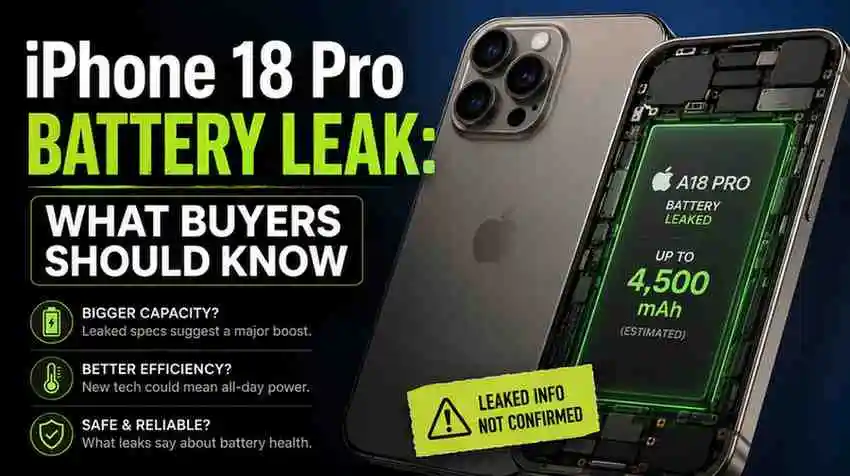
Apple has not officially announced the iPhone 18 Pro lineup yet, but the first detailed battery-capacity leak has already started an important discussion. According to a report published on June 2, 2026, Apple is allegedly testing different battery sizes for the U.S. and Chinese versions of the iPhone 18 Pro. The difference appears to be linked to the physical SIM card tray rather than a major change in battery technology.
The rumored figures suggest that the China version of the iPhone 18 Pro may feature a battery capacity of approximately 4,056 mAh. The U.S. eSIM-only version could receive a slightly larger 4,288 mAh battery. These numbers represent a limited increase over the equivalent iPhone 17 Pro models.
At first glance, the upgrade may not seem particularly exciting. Smartphone buyers often expect every new flagship model to offer a noticeable jump in battery size. However, battery capacity is only one part of the overall picture. Processor efficiency, modem power consumption, thermal management, display technology, software optimization, and daily usage patterns can all influence how long a phone lasts between charges.
The iPhone 18 Pro Max could be more interesting for users who prioritize endurance. Previous reports have suggested that Apple may equip the larger model with a battery between 5,100 and 5,200 mAh. If accurate, this could make it one of the largest batteries ever used in an iPhone.
It is important to treat these figures as unconfirmed information. Apple may still adjust the final specifications before the expected release period. Even so, the leak offers a useful early look at the direction Apple may be taking with its next Pro lineup.
iPhone 18 Pro Battery Capacity Leak at a Glance
The latest leak reportedly comes from Digital Chat Station, a Weibo-based tipster known for sharing smartphone supply-chain information. The report claims that Apple is testing two versions of the smaller iPhone 18 Pro.
iPhone 18 Pro VersionRumored Battery CapacitySIM ConfigurationDifference Compared With Equivalent iPhone 17 Pro
China model Approximately 4,056 mAh Physical SIM tray +68 mAh
U.S. model Approximately 4,288 mAh eSIM-only +36 mAh
The physical SIM tray occupies internal space. Removing it gives manufacturers more room to use for other components, including a slightly larger battery. This is why the eSIM-only U.S. model may have a higher capacity than the version sold in China.
The key detail is that both iPhone 18 Pro versions are rumored to receive increases, but neither is dramatic. The China model could gain around 1.7%, while the U.S. version could increase by approximately 0.8%.
iPhone 18 Pro vs iPhone 17 Pro Battery Comparison
The iPhone 17 Pro lineup already introduced a noticeable difference in battery capacity between physical-SIM and eSIM-only versions. If the latest iPhone 18 Pro leak is accurate, Apple may continue using the same strategy.
ModelChina or Physical-SIM Version, U.S. or eSIM-Only Version, Maximum Capacity Increase
iPhone 16 Pro 3,582 mAh 3,582 mAh Baseline
iPhone 17 Pro 3,988 mAh 4,252 mAh Up to 18.7% over iPhone 16 Pro
iPhone 18 Pro Approximately 4,056 mAh Approximately 4,288 mAh Up to 1.7% over the equivalent iPhone 17 Pro version
The table shows an important pattern. The major battery upgrade happened with the iPhone 17 Pro, not necessarily the iPhone 18 Pro. Apple may be focusing on refinement this time rather than a major capacity increase.
For the U.S. version, the rumored difference between the iPhone 17 Pro and iPhone 18 Pro is only 36 mAh. In practical terms, users may not notice a major improvement from battery size alone. Meaningful real-world gains will likely come from better efficiency elsewhere in the device.
iPhone 18 Pro Max Battery Capacity Could Be More Promising
The larger iPhone 18 Pro Max may receive a more noticeable battery upgrade. Earlier reports suggested a capacity of approximately 5,100-5,200 mAh. The current iPhone 17 Pro Max eSIM-only model reportedly uses a 5,088 mAh battery.
Model Reported or Rumored Battery Capacity Difference Compared With Previous Pro Max
iPhone 16 Pro Max 4,685 mAh Baseline
iPhone 17 Pro Max eSIM-only version 5,088 mAh +403 mAh
iPhone 18 Pro Max Rumored 5,100 to 5,200 mAh Approximately +12 to +112 mAh
Even at the upper end of the rumored range, the increase remains moderate. However, the Pro Max model may benefit more from efficiency improvements, as its larger battery provides a stronger foundation for extended use.
The iPhone 17 Pro Max already offers impressive endurance. Apple lists up to 39 hours of video playback and up to 35 hours of streamed video playback for the U.S. version. If the next model combines a slightly larger battery with a more efficient processor, it may exceed the 40-hour video playback mark. However, that remains an informed expectation rather than a confirmed specification.
Why the U.S. and China Models May Have Different Battery Sizes
Apple removed the physical SIM tray from U.S. iPhones starting with the iPhone 14 lineup. Instead of inserting a plastic SIM card, U.S. buyers activate cellular service through eSIM technology.
In China, physical SIM support remains important. As a result, some iPhone models sold in the Chinese market still include a SIM tray. This small hardware component takes up valuable internal space.
Smartphone design requires careful trade-offs. Manufacturers must fit cameras, speakers, antennas, cooling components, processors, storage modules, wireless charging hardware, and batteries inside a thin enclosure. Even a small amount of additional space can help engineers increase battery capacity.
This explains why the rumored U.S. iPhone 18 Pro battery could be approximately 232 mAh larger than the Chinese version. It does not necessarily mean that one market is receiving a more premium product. The difference may reflect the internal space available after removing the SIM tray.
Battery Capacity Does Not Tell the Full Story
Battery capacity is usually measured in milliampere-hours (mAh). A higher number can indicate that a battery stores more charge, but it does not automatically guarantee longer battery life.
Two smartphones with the same battery capacity can deliver very different results. One device may last longer because its processor consumes less power. Another may drain faster because it uses a brighter display, a weaker modem, less efficient software, or more aggressive background activity.
A complete battery-life evaluation should consider several factors:
Battery-Life Factor: Why It Matters
Battery capacity determines how much charge the phone can store
Processor efficiency influences power use during Gaming, video editing, browsing, and general tasks
Modem efficiency affects battery drain during mobile-data usage, calls, and weak-signal conditions
Display brightness: Higher brightness can consume more power, especially outdoors
Refresh rate: Adaptive refresh-rate technology can reduce unnecessary power usage
Thermal management: Excess heat may reduce efficiency and affect long-term battery health
Software optimization. Background apps, system processes, and updates can influence daily endurance
Network conditions: Poor signal strength can increase power consumption
Camera usage: High-resolution video recording and advanced camera features require more energy
This is why a small increase in battery capacity should not be dismissed out of hand. A modest battery upgrade can still produce useful results when combined with improvements across the rest of the device.
The Rumored A20 Pro Chip Could Matter More Than the Battery Increase
The iPhone 18 Pro lineup is expected to introduce Apple’s next-generation A20 Pro processor. Reports suggest that the chip may use TSMC’s 2-nanometer manufacturing process.
A smaller manufacturing process can improve efficiency by allowing more transistors to fit into a compact space. In practical terms, the phone may be able to complete demanding tasks while using less energy. The exact gains will depend on Apple’s final design, thermal limits, software tuning, and workload behavior.
Rumors suggest the A20 generation could offer greater efficiency than the A19 series. If that happens, the processor upgrade could contribute more to daily battery life than the additional 36 mAh reported for the U.S. iPhone 18 Pro.
This distinction matters for buyers. A battery upgrade should not be judged solely by comparing mAh figures. If Apple improves performance per watt, the iPhone 18 Pro may deliver longer usage without requiring a much larger battery.
Could the iPhone 18 Pro Deliver Noticeably Better Battery Life?
The answer depends on the final hardware and software combination.
For the smaller iPhone 18 Pro, the rumored capacity increase is limited. Users upgrading from an iPhone 17 Pro may not see a significant improvement in battery life solely from a larger battery. The difference could be more visible during specific tasks if Apple reduces processor or modem power consumption.
Users upgrading from an older device, such as an iPhone 15 Pro or iPhone 16 Pro, may notice a more meaningful change. Battery improvements often become easier to appreciate across two or three generations rather than through yearly upgrades.
The Pro Max model could remain the better option for users who regularly record video, navigate with GPS, use mobile data for long periods, attend video calls, edit content, or play demanding games. Its larger physical size gives Apple more space for a higher-capacity battery.
Pros and Cons of the Rumored iPhone 18 Pro Battery Upgrade
Potential Pros
Advantage: Why It Could Matter
Slightly larger battery in both reported versions. Even a modest increase can support longer usage when combined with improved efficiency.
Larger eSIM-only U.S. battery. Removing the SIM tray may allow Apple to better utilize internal space.
Potential A20 Pro efficiency gains: A more efficient processor could reduce battery drain during demanding tasks.
Possible improvement in standby time. Better modem and software optimization may help users who spend long periods away from a charger
Stronger Pro Max endurance. The rumored 5,100 to 5,200 mAh battery could make the Pro Max attractive to power users.
Better upgrade experience for older iPhone owners . Users switching from older Pro models may notice a more meaningful difference.
Potential Cons
Limitations: Why Buyers Should Consider It
Small year-over-year increase for the standard Pro . The U.S. iPhone 18 Pro may gain only around 36 mAh compared with the equivalent iPhone 17 Pro.
Regional battery differences : Buyers in markets with physical SIM support may receive a smaller battery.
Pro Max size may remain a concern . A larger battery may contribute to a heavier or thicker device.
Charging improvements remain unclear . A larger battery is more useful when charging speed and heat management are also improved.
Real-world results may vary . Gaming, camera use, mobile signal strength, brightness, and background apps affect battery life.
Leak has not been confirmed . Apple could change the specifications before launch.
Is a 36 mAh Increase Too Small to Matter?
For the U.S. iPhone 18 Pro, the rumored increase from 4,252 mAh to 4,288 mAh is small. It is unlikely to transform the daily experience on its own.
However, improvements in smartphones are often cumulative. A small battery increase, a more efficient chip, better modem behavior, refined cooling, and updated software can work together. The final result may be more noticeable than the mAh difference suggests.
It is also possible that Apple is prioritizing internal space for other upgrades. Camera components, display hardware, sensors, connectivity chips, and cooling systems all compete for room inside a compact device.
A modest increase in battery capacity does not necessarily indicate a lack of progress. It may reflect a design balance between battery life, performance, camera quality, size, weight, and durability.
How the iPhone 18 Pro Could Compare With Android Flagships
Many premium Android smartphones already use batteries with capacities around 5,000 mAh or higher. Some models have moved beyond that figure by using newer battery materials and different internal designs.
This can make Apple’s rumored 4,288 mAh figure seem conservative. However, direct comparisons are not always straightforward. Battery capacity should be evaluated alongside operating-system behavior, chip efficiency, display characteristics, app usage, network conditions, and performance settings.
An Android phone with a larger battery does not automatically last longer than an iPhone in every scenario. Similarly, an iPhone with efficient hardware does not automatically win every battery test.
The best comparison will come after launch, when independent reviewers can test the iPhone 18 Pro under controlled conditions. Useful tests should include web browsing, video streaming, camera recording, Gaming, standby drain, mobile-data usage, charging speed, and thermal behavior.
What Existing iPhone 17 Pro Battery Claims Tell Us
Apple’s official U.S. specifications list the following battery-life estimates for the iPhone 17 Pro lineup:
ModelVideo PlaybackStreamed Video Playback
iPhone 17 Pro Up to 33 hours Up to 30 hours
iPhone 17 Pro Max Up to 39 hours Up to 35 hours
These figures provide a useful reference point, but they should not be treated as a guarantee for every user. Real-world results depend on screen brightness, network strength, background apps, camera use, Gaming, charging habits, temperature, and other factors.
Apple also notes that rechargeable batteries have a limited lifespan. Over time, lithium-ion batteries chemically age and hold less charge. This affects both runtime and peak performance.
A new phone may perform well during its first months of use, but long-term battery satisfaction also depends on thermal management and charging habits.
What Buyers Should Check After the Official Launch
Rumors can help buyers understand what may be coming, but the final decision should be based on official specifications and independent testing.
After Apple announces the iPhone 18 Pro lineup, buyers should check:
- The official battery-life claims for both the iPhone 18 Pro and iPhone 18 Pro Max.
- Whether battery capacity varies by country or SIM configuration.
- Independent browsing, streaming, Gaming, and camera-recording tests.
- Charging speed through USB-C, MagSafe, and compatible wireless chargers.
- Thermal performance during Gaming, navigation, and video recording.
- Standby drain during overnight or low-usage periods.
- Weight and thickness differences compared with the iPhone 17 Pro lineup.
- Battery-health performance after several months of real-world use.
This approach is more reliable than focusing on a single leaked number.
Should You Wait for the iPhone 18 Pro?
Waiting may make sense for users who own an older iPhone, want better long-term battery life, or are interested in the expected processor improvements. The iPhone 18 Pro Max may be particularly appealing to people who value endurance over compact size.
However, existing iPhone 17 Pro users should keep expectations realistic. Based on reported battery capacities, the standard iPhone 18 Pro may not offer a significant increase in battery capacity. The more meaningful gains could come from efficiency improvements rather than raw capacity.
Users who need a phone immediately should not base a purchase decision entirely on an unconfirmed leak. The iPhone 17 Pro lineup already offers strong battery-life figures, especially in the larger Pro Max configuration.
For users who can wait, the official announcement and independent reviews will provide a clearer answer.
Final Verdict
The alleged iPhone 18 Pro battery-capacity leak points to a careful, incremental upgrade rather than a dramatic redesign of Apple’s battery strategy.
The smaller iPhone 18 Pro is rumored to feature a battery of approximately 4,056 mAh in China and 4,288 mAh in the U.S. The difference is likely connected to the physical SIM tray. Compared with the iPhone 17 Pro, the increase is modest.
The iPhone 18 Pro Max may offer more interest for power users, with previous reports suggesting a battery between 5,100 and 5,200 mAh. Combined with the expected efficiency improvements of the A20 Pro chip, the larger model could deliver Apple’s strongest iPhone battery life yet.
The key point is simple: battery capacity is important, but it is not the only specification that matters. The real test will come when Apple confirms the final hardware and independent reviewers evaluate everyday performance.
Until then, the leaked figures should be viewed as an early indication of Apple’s direction, not as final specifications.
Frequently Asked Questions
What is the rumored battery capacity of the iPhone 18 Pro?
The U.S. eSIM-only iPhone 18 Pro is rumored to feature an approximately 4,288 mAh battery. The Chinese version with a physical SIM tray may use an approximately 4,056 mAh battery.
Is the iPhone 18 Pro battery capacity officially confirmed?
No. Apple has not confirmed the reported battery capacities. The figures are based on an alleged leak and may change before the official launch.
Why could the U.S. iPhone 18 Pro have a larger battery?
The U.S. model is expected to remain eSIM-only. Removing the physical SIM tray creates additional internal space that can accommodate a slightly larger battery.
How much larger could the iPhone 18 Pro battery be than the iPhone 17 Pro battery?
The U.S. model may increase from 4,252 mAh to approximately 4,288 mAh, a difference of around 36 mAh. The China model may increase from 3,988 mAh to approximately 4,056 mAh, a difference of around 68 mAh.
What is the rumored battery capacity of the iPhone 18 Pro Max?
Earlier reports suggested that the iPhone 18 Pro Max may feature a battery of 5,100-5,200 mAh.
Will the iPhone 18 Pro have much better battery life?
It is too early to say. The standard Pro model may receive only a small capacity increase. However, improvements in processor efficiency, modem behavior, thermals, and software optimization could still improve real-world battery life.
Is mAh the only factor that determines battery life?
No. Battery capacity is only one factor. Processor efficiency, display brightness, refresh rate, mobile signal quality, camera use, software behavior, heat, and background apps can all affect battery life.
Should iPhone 17 Pro users upgrade just for the battery?
Based on the current leak, upgrading solely for the standard iPhone 18 Pro battery may not be necessary. The final decision should depend on official specifications, independent tests, and the complete list of upgrades.

